
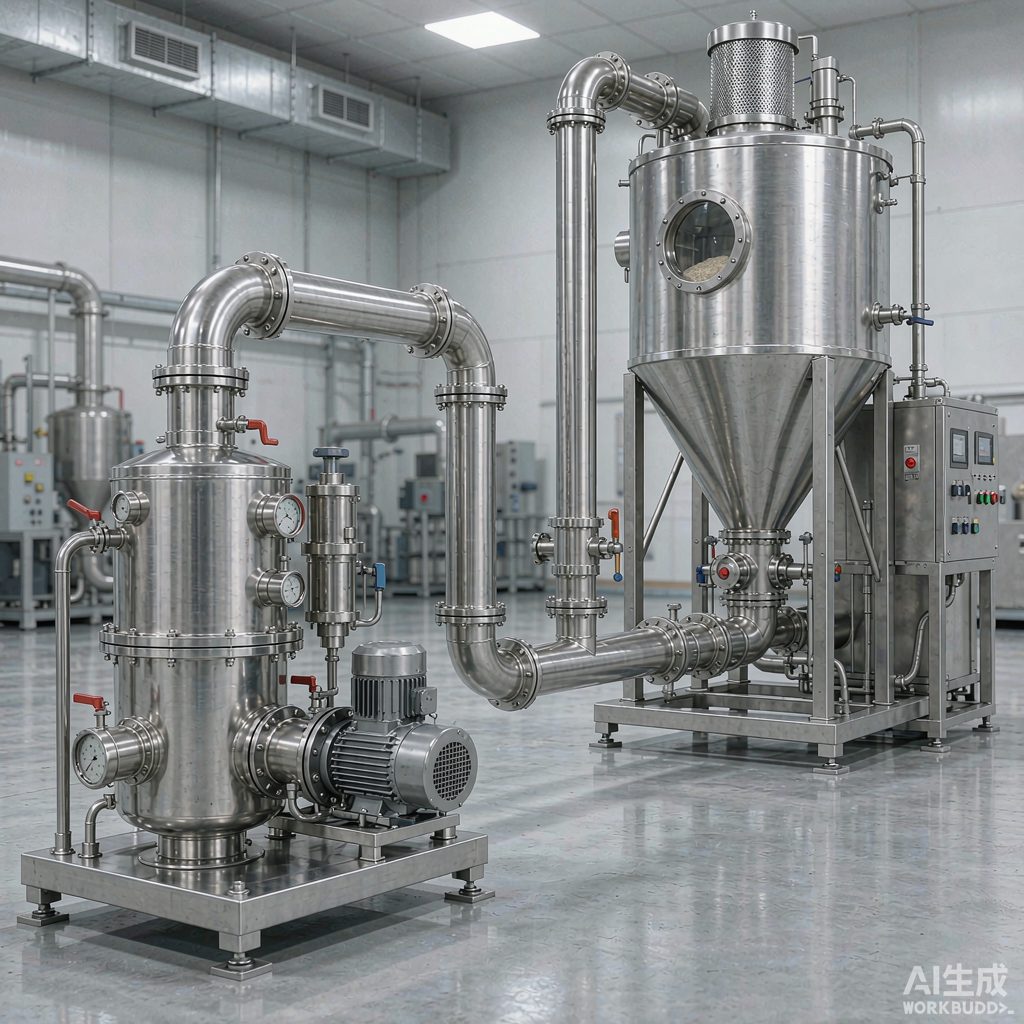
Every battery material conveying decision starts with one trade-off: move the powder fast and gently (dilute-phase, high velocity) or slow and protected (dense-phase, low velocity). Get it wrong in the cathode plant and you pay for it in tap density drift, iron contamination and wear-part budgets. Here is how the two modes actually compare — with the numbers we design to.
The Physics in One Paragraph Each
Dilute-phase suspends particles fully in the air stream at 18–35 m/s. Every particle is airborne, every particle contacts the pipe wall repeatedly. Pressure drop is moderate, equipment is compact, and the air velocity does the damage.
Dense-phase moves material in slow-moving plugs or beds at 2–8 m/s with much higher solids loading. Particles spend most of the journey in the material stream, not against the wall. Pressure is higher, control is harder — but the powder arrives as it left.
Side-by-Side for Cathode Powders
| Dilute-Phase | Dense-Phase | |
|---|---|---|
| Air velocity | 18–35 m/s | 2–8 m/s |
| Particle attrition | High — repeated wall impacts | Low — plug flow, minimal wall contact |
| Iron pickup from bends | Significant, rises with wear | Minimal with ceramic-lined long-radius bends |
| TAP density impact | Can drift measurably | Stable batch to batch |
| Wear-part budget | Bends every 6–12 months | Typically 2–4× longer intervals |
| Energy per ton moved | Higher air volume, lower pressure | Lower air volume, higher pressure — net lower above ~3,000 kg/h |
| Best for | Short internal transfers, non-abrasive powders | LFP, NCM, LCO — anything iron-sensitive or abrasive |
The Decision Rule We Apply
For lithium cathode powders the rule is simple: if the material is iron-sensitive, abrasive or morphology-critical, dense-phase wins on everything except first cost — and usually wins there too within two years. Dilute-phase survives in cathode plants only on short, straight, inspectable internal transfers where a wear failure is cheap to find and fix.
What This Means for Your Line
- Ask any supplier for design velocity per pipe leg, not just the mode name
- Request bend material and radius specification in writing — it is the wear and iron line-item
- For NCM/NCA, add the atmosphere question: dense-phase loops on dry air or N₂ with dew-point control
- Size the decision on 24-month cost, not install cost — wear parts and rejected batches are where the money goes
Free Conveying Mode Assessment
Send us your material data sheet and target throughput — our engineers will return a conveying mode recommendation with design velocities and expected wear intervals, free of charge, within 48 hours.
Request Free Assessment